How Often Should You Change Your Engine Oil?

There is no single mileage that fits every car. Many modern vehicles that use synthetic oil go roughly 5,000 to 10,000 miles between oil changes, and some go further, but your owner’s manual and your car’s oil-life monitor set the real answer for your engine. This guide is for everyday US drivers who want a reliable way to decide when an oil change is due. It cannot tell you the exact interval for your specific vehicle, so confirm it in your owner’s manual.
Quick answer
- Follow your owner’s manual first. It lists the interval, the oil type, and the oil specification for your exact engine.
- If your car has an oil-life monitor, follow it, and use the oil type the manufacturer specifies.
- Older cars without a monitor often have two schedules in the manual: normal and severe service.
- Towing, short trips, extreme temperatures, and dusty roads can shorten the interval.
- Do not rely on the old 3,000-mile rule or on oil color alone.
| Your situation | What to do |
|---|---|
| Newer car with an oil-life monitor | Follow the monitor’s alert and your owner’s manual |
| Car without an oil-life monitor | Follow the maintenance schedule in your owner’s manual |
| Hard driving (towing, heavy traffic, extreme heat or cold) | Follow the severe-service schedule if your manual lists one |
| Low annual mileage | Respect the time limit as well as the mileage |
| Older car | Follow the manufacturer’s recommendation and check the oil level regularly |
Why oil changes matter
Engine oil lubricates moving parts, helps carry heat away, and suspends contaminants so they can be carried through the lubrication system. The oil filter traps many of the particles circulating in the oil, while an oil change removes the used oil and the contaminants that have accumulated over time.
Over time oil breaks down and collects combustion byproducts, dirt, and moisture. Worn-out oil protects less, and long gaps between changes can lead to sludge, extra wear, and in the worst cases engine damage.
What decides your oil change interval
The manufacturer’s recommendation
Automakers set intervals based on the engine design, the oil specification, and expected driving conditions. Recommendations differ between brands and even between models and engines of the same brand, so a figure that suits one car may not suit yours.
Oil type
| Oil type | Typical comparison | Check before relying on it |
|---|---|---|
| Conventional | Usually the shortest interval | Many modern engines are not designed for it |
| Synthetic blend | Middle ground | Your manual may still specify a lower mileage |
| Full synthetic | Usually the longest interval | Must meet the exact specification in your manual |
Oil type alone does not determine the change interval. Always follow the interval and oil specification recommended for your engine.
Some engines require full synthetic oil, so you cannot always switch to a cheaper type. Using oil that does not meet the manufacturer’s required specification can reduce engine protection and may affect warranty coverage, depending on the vehicle and the warranty terms.
Your driving conditions
Manufacturers often call harder use “severe service.” It typically includes:
- Frequent short trips where the engine rarely reaches full operating temperature
- Towing or hauling heavy loads
- Stop-and-go city traffic and extended idling
- Very hot or very cold climates
- Dusty, muddy, or unpaved roads
Many drivers meet at least one of these without realizing it. If your owner’s manual lists a severe-service schedule and your driving fits it, follow the shorter schedule.
An oil-life monitor, if your car has one
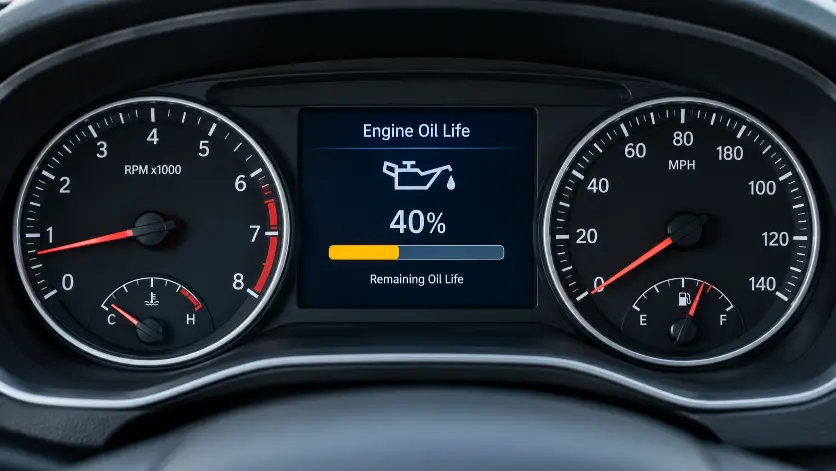
Many newer cars use an oil-life monitor and alert you on the dashboard when a change is due. Some monitors only count miles, and your owner’s manual explains which type you have.
Some vehicles use an oil-life monitor to adjust the recommended change interval based on driving conditions. However, not all systems work the same way, and some manufacturers still specify additional maintenance requirements for severe service. Check your owner’s manual to understand how your vehicle’s system works and whether a separate severe-service schedule applies.
How to decide when yours is due
- Find the maintenance section of your owner’s manual. Note the interval, the oil type, and the viscosity and specification it calls for.
- Check whether your car has an oil-life monitor. If it does, the dashboard may display a remaining oil-life percentage, a maintenance message, or a warning indicator, depending on the vehicle. The manual explains how to read it.
- Compare your driving to the severe-service list above. If it fits and your car has no monitor, use the shorter schedule.
- Note the time limit as well as the mileage. Many manuals say “X miles or Y months, whichever comes first.” For example, if your manual recommends a change every 7,500 miles or 12 months, whichever comes first, you should change the oil after 12 months even if you have driven fewer than 7,500 miles. This example is hypothetical, so use the numbers in your own manual.
- Check your oil level between changes. Our guide on how to check engine oil level walks through the dipstick method. Some engines burn or leak a little oil, and a low level needs attention whatever the schedule says.
- Do not keep driving with a warning light. If the oil pressure warning light comes on while driving, safely pull over as soon as possible and shut off the engine. Do not continue driving to reach a repair shop. Have the vehicle inspected before restarting it.

How to read what you find
- A low oil-life percentage means a change is due or coming soon. It does not mean the engine is damaged.
- Dark oil on the dipstick does not prove the oil is bad. Oil darkens quickly as it works. Color alone is not a reliable signal, so go by the monitor or the schedule.
- Milky or creamy oil on the dipstick can indicate coolant contamination, although light residue under the oil filler cap can sometimes result from condensation, especially with short trips. Oil that smells strongly of fuel may indicate fuel dilution. Either condition deserves further inspection rather than waiting for the next scheduled oil change.
- A level that drops between changes suggests the engine is using or leaking oil. That is a separate issue to diagnose, and a shorter interval does not fix it.
Common mistakes
- Following the 3,000-mile rule out of habit. It dates from older engines and oils. Changing oil more often than the manufacturer recommends is not usually necessary when you use the correct oil and follow the correct schedule, and excessively frequent changes add cost and waste oil.
- Stretching intervals past the manual. Going well beyond the recommendation, especially with severe driving, risks extra engine wear.
- Forgetting to reset the oil-life monitor after a change. The reset procedure is in your owner’s manual, and a shop should do it for you.
- Using the wrong viscosity or specification because it was cheaper or already on the shelf.
- Ignoring the time limit on a car that is rarely driven.
- Relying on the windshield sticker. It is a reminder, not a specification for your engine.
When to see a professional
Get a qualified technician’s help if:
- The oil pressure warning light is on, or the engine makes new knocking sounds
- You regularly need to add oil between changes
- The oil looks milky or smells of fuel
- You are unsure which oil your engine requires
- You see oil leaking under the car
Low or poor-quality oil can also contribute to engine heat problems. If your temperature gauge climbs, read our guide on common causes of engine overheating, and stop driving if the engine is overheating.
Frequently asked questions
Is 5,000 miles too long between oil changes?
Not necessarily. For many vehicles, 5,000 miles is within the recommended range, but the correct interval depends on the engine, oil specification, and driving conditions. Check your owner’s manual.
Can I go 10,000 miles on synthetic oil?
Some manufacturers allow it with the correct oil and under normal driving. Others do not. Check your owner’s manual and your oil-life monitor rather than assuming.
Do I need an oil change if I barely drive?
In most cases, yes. Oil ages even when the car sits, and many manuals include a time limit alongside the mileage.
Should I change the oil filter every time?
Generally yes. A new filter is usually installed with fresh oil. Your owner’s manual or a technician can confirm what your vehicle needs.
Conclusion
Open your owner’s manual, find the oil change interval and the required oil specification, and follow the oil-life monitor if your car has one. If your driving is hard on the engine, use the shorter schedule. Between changes, check the oil level now and then and act on any warning lights.
This article is general educational information. Intervals and oil specifications vary by vehicle, so always confirm them in your owner’s manual or with a qualified technician.
Sources and further reading
- Your vehicle’s owner’s manual and the manufacturer’s maintenance schedule (primary source for interval, oil type, and specification)
- AAA: How Often Should You Change Engine Oil
- AAA: How Often Should I Change My Synthetic Oil?
Related articles
How to Check Tire Pressure and Find the Correct PSI
To check tire pressure, use a reliable gauge when your tires are cold and compare each reading with the recommended PSI on your vehicle’s…
How to Check Engine Oil Level Correctly (Step-by-Step Guide)
Knowing how to check engine oil level correctly helps you protect your engine from unnecessary wear and potentially expensive damage. The process usually takes…