Why Is My Engine Overheating? Common Causes and Safe Checks
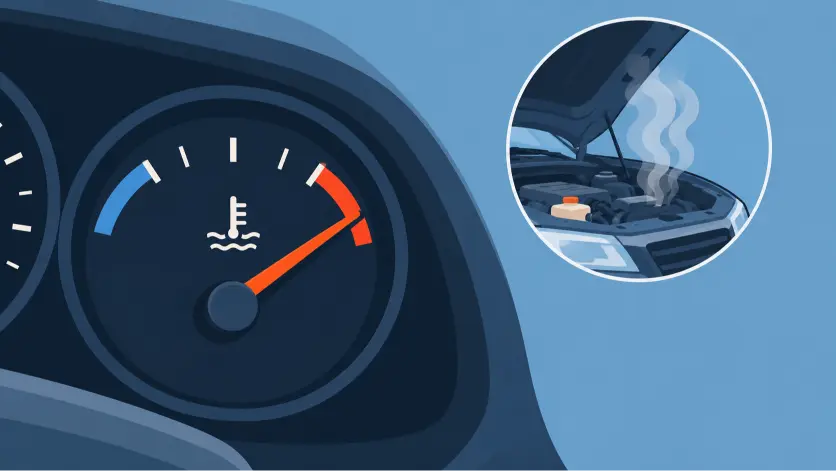
An engine usually overheats because the cooling system cannot move heat away fast enough. Common reasons include low coolant, a stuck thermostat, a failing water pump, a clogged radiator, a faulty radiator fan, or a leaking hose or cap. This guide is for US drivers with basic mechanical knowledge who want to understand the likely causes and run a few safe checks. It cannot diagnose your car remotely, and exact procedures and specifications vary by vehicle.
Key points
- If the temperature gauge enters the red zone or an engine-temperature warning appears, pull over safely and turn off the engine. Driving while the engine is overheating can cause serious damage.
- Low coolant is one of the first things to check, but a low level may indicate a leak or another cooling-system problem. Finding and correcting the underlying cause is more reliable than repeatedly topping off the reservoir.
- Never open a radiator or coolant reservoir cap on a hot engine. Pressurized coolant can cause severe burns.
- One symptom does not prove one failed part. Avoid replacing parts by guesswork.
Is it safe to keep driving?
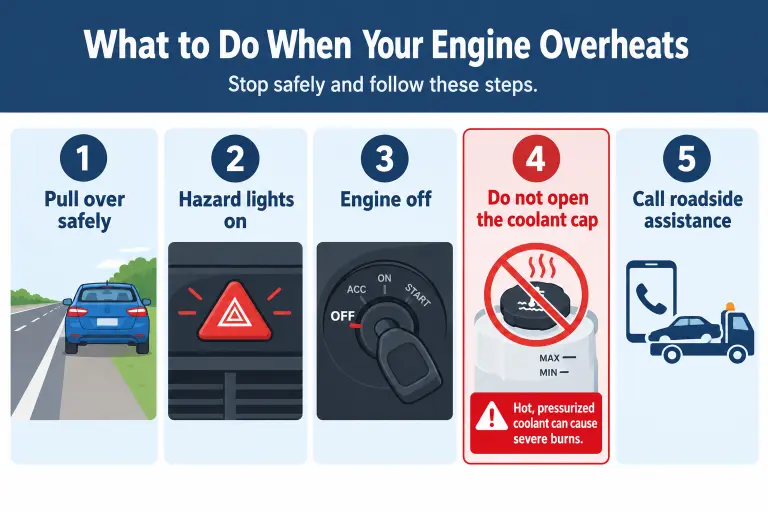
No. If you see any of the following, stop as soon as it is safe to do so:
- The temperature gauge is at or near the red zone, or an engine temperature warning appears on the dash
- Steam or smoke is coming from under the hood
- You smell a sweet, syrupy odor (often coolant) or burning
- The engine is knocking, losing power, or running roughly
Turn the engine off, put on the hazard lights, and let the engine cool completely before inspecting anything. Cooling time varies by vehicle and conditions, so do not rely on a fixed waiting period. Never open a hot, pressurized cooling system. Check your owner’s manual for the manufacturer’s guidance on overheating, because instructions differ between vehicles. If you cannot identify the cause, or you see steam or heavy coolant loss, call roadside assistance rather than restarting the engine.
How the cooling system works
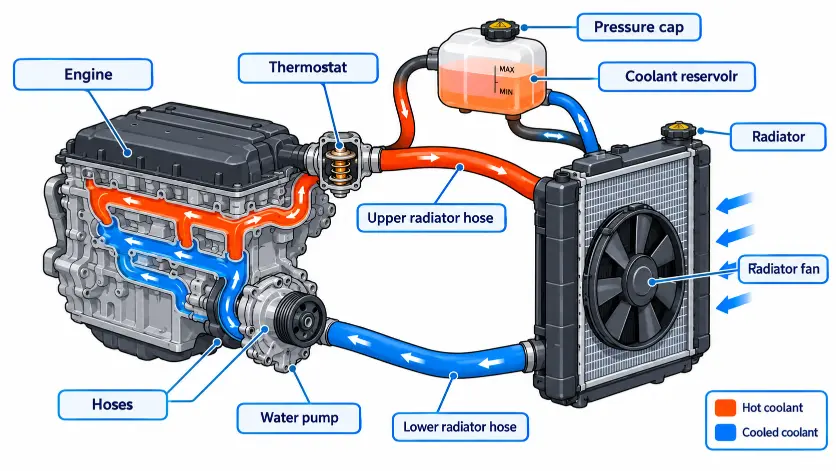
Your engine produces a lot of heat. Coolant (a mix of antifreeze and water) circulates through the engine, absorbs heat, and carries it to the radiator, where airflow cools it. A water pump keeps the coolant moving, and a thermostat controls when coolant flows to the radiator so the engine reaches and holds its normal operating temperature. A pressurized system and cap raise the coolant’s boiling point. A fan (or fans) pulls air through the radiator when the car is slow or stopped. If any of these parts fails or is restricted, temperature can climb quickly.
Most common causes of engine overheating
| Cause | Typical clues | Notes |
|---|---|---|
| Low coolant level | Low reservoir, warning light, heater blowing cool air | Coolant does not normally disappear. Look for a leak. |
| Coolant leak (hose, radiator, water pump, gasket) | Puddles under the car, sweet smell, visible residue or crusty deposits | Leaks can be small and only appear under pressure. |
| Stuck thermostat | Abnormal coolant circulation or rapid overheating | Symptoms alone do not confirm thermostat failure. |
| Faulty radiator fan or fan relay | Overheats in traffic or at idle but improves at highway speed | Many vehicles use electric fans controlled by a sensor or the computer. |
| Clogged or restricted radiator | Gradual overheating, especially under load, or debris blocking the fins | Can be external (bugs, leaves) or internal (deposits, old coolant). |
| Failing water pump | Coolant leak near the pump, whining or grinding noise, loose pulley | Not all failing pumps make noise. |
| Bad radiator cap | Coolant boiling over, reservoir pushed out | The cap holds system pressure. A weak cap lowers the boiling point. |
| Air trapped in the system | Overheating after a coolant service or repair | Some vehicles need a specific bleeding procedure. |
| Old or incorrect coolant | Discolored or rusty fluid, poor heat transfer | Use only the coolant type your manual specifies. |
| Possible signs of an internal engine or coolant-system problem | White exhaust smoke, bubbles in the coolant, milky oil, repeated overheating | Needs professional diagnosis. |
These are possibilities, not confirmed diagnoses. Several can appear together, and some causes can produce misleading symptoms.
Checks you can do safely
Start with low-risk observations before touching anything. Always work on a cool engine, on level ground, with the ignition off unless a step says otherwise.
- Look for obvious signs. Check under the car for puddles and around the hoses, radiator, and water pump for wet spots or dried residue. Coolant is often green, orange, pink, or blue, but color varies by type.
- Check the coolant reservoir level. Many vehicles have a translucent overflow tank with MIN and MAX marks. Read the level only when the engine is cold. If it is low, note that it is a clue and not the full answer.
- Inspect the radiator fins. Look through the grille for leaves, bugs, plastic bags, or bent fins that restrict airflow.
- Inspect hoses and belts. With the engine off and cold, look for cracks, bulges, or collapsed hoses, and a belt that is loose, glazed, or frayed (on vehicles where the belt drives the water pump).
- Check for possible fan problems without putting yourself at risk. If the engine overheats in traffic or while idling, a radiator fan or its control circuit may be at fault. Do not reach near the fan or belts while the engine is running; electric fans can start unexpectedly. Leave operational testing to a qualified technician if you are unsure how to perform it safely.
- Check the owner’s manual. It will show the correct coolant type, the correct way to add coolant, and any vehicle-specific warnings.
Stop if: you see heavy leaking, steam, a cracked reservoir, coolant in the oil, or a gauge that returns to the red soon after you restart. Do not keep driving to “see if it clears up.”
Adding coolant: what to know
If the level is low and the engine is completely cold, you may be able to top it off. Use the type of coolant your manual calls for, and mix ratios as directed on the product. Do not mix different coolant types unless the manual allows it. Do not use plain water as a long-term fix, because it reduces freeze and corrosion protection. If you must use water in an emergency, have the system checked and corrected as soon as possible. Adding coolant may temporarily restore the correct level, but it does not fix the underlying problem. If the coolant level keeps dropping, have the system checked for a leak or another fault.
How to interpret what you find
- Low coolant with a visible leak: The leak is a likely cause, but the repair location and part still need confirmation.
- Low coolant with no visible leak: The coolant may be leaking internally or only under pressure. A pressure test by a technician can help find it.
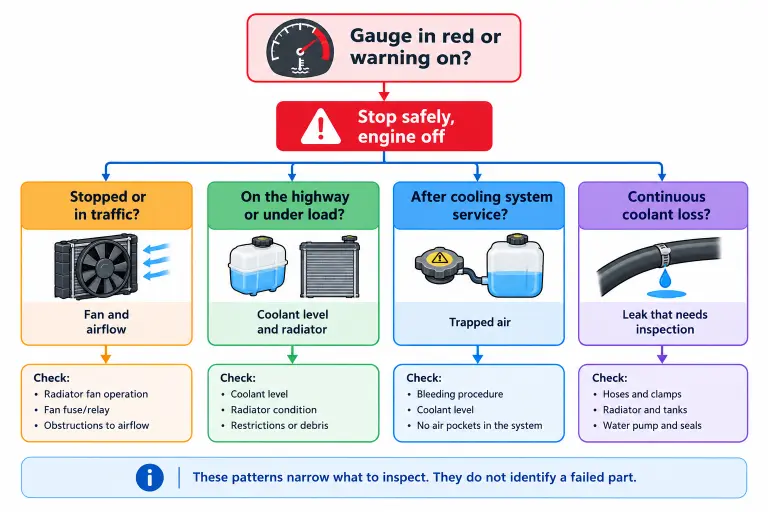
- Coolant is full, but the engine overheats: Think about the thermostat, fan, water pump, radiator restriction, or trapped air.
- Overheats only at idle or in traffic: Points toward fan or airflow problems more than a thermostat problem, though it is not proof.
- Overheats on the highway under load: Can suggest a restricted radiator or reduced coolant flow.
- Rises quickly right after startup: Often points toward a thermostat that is not opening, or a major coolant loss.
What the symptoms do not tell you
A hot gauge does not tell you which part has failed. A failed fan, for example, looks very similar to a stuck thermostat from the driver’s seat. A faulty temperature sensor can also give a false reading, which is one reason a technician may confirm the real temperature with a separate tool. Replacing the radiator, water pump, or thermostat based on a guess can waste money and leave the real problem in place.
If a check engine light or another warning light is also on, read our guide to what the check engine light means. A basic OBD-II scanner can show stored trouble codes, but a code points to a system to test, not automatically to a part to replace. A code alone cannot identify the mechanical cause of overheating; a technician may also check the coolant level, pressure-test the cooling system, and measure the actual engine temperature, depending on the vehicle.
Common mistakes
- Opening the radiator cap on a hot engine. This can release scalding coolant. Wait until the engine is fully cool.
- Pouring cold water into a hot engine. A sudden temperature change can damage metal parts.
- Driving “just a little farther.” Even a few minutes can cause lasting damage, including a warped cylinder head or blown head gasket.
- Topping off repeatedly without finding the leak.
- Using the wrong coolant. Incorrect coolant can harm seals and reduce corrosion protection.
- Ignoring a heater that suddenly blows cool air. It can indicate low coolant or air in the system.
When to get professional help
See a qualified technician if:
- The engine overheats more than once, or the cause is not obvious
- You find a leak you cannot identify or repair safely
- There is white exhaust smoke, a milky substance under the oil cap, or bubbles in the coolant
- The engine ran hot for a significant time or lost power
- The fan does not run when it should
- You are not comfortable working around hot, pressurized, or moving parts
Tell the technician what happened: when the overheating occurs (idle, highway, after startup), the gauge reading and any warning lights, any steam or smells, recent repairs or coolant top-ups, and how much coolant you had to add.
If you suspect coolant is getting into the oil, our guide on how to check engine oil level shows how to read the dipstick on a cold engine. Stop driving if there are clear signs of contamination, such as milky oil on the dipstick, and arrange a professional inspection. Milky residue under the oil cap alone does not confirm a head gasket failure or an internal coolant leak.
Frequently asked questions
Can I drive with the temperature gauge slightly above normal? If the gauge rises above its usual position, monitor the warning indicators and follow your owner’s manual. If the temperature continues to rise or an overheating warning appears, pull over safely and turn off the engine. Do not continue driving an engine that is overheating.
Why does my car overheat only in traffic? A common explanation is reduced airflow through the radiator, such as a fan that is not working properly. Other causes are possible, so it still needs checking.
Will turning on the heater help? Some drivers do this as an emergency measure because it moves some engine heat into the cabin. It is not a repair, and it does not make continued driving safe. Pull over if the temperature keeps rising.
How long should I wait before checking the coolant? There is no single safe waiting time for every vehicle. Allow the engine and cooling system to cool completely, and never open a hot, pressurized coolant cap. Follow the owner’s manual before checking or adding coolant.
Can low coolant alone cause overheating? Yes, but coolant rarely goes down without a reason. Find out why it is low.
Conclusion
Engine overheating is a symptom with many possible causes, from a simple low coolant level to a failed thermostat, fan, or water pump. The safest next steps are to stop driving, let the engine cool, check for obvious problems, consult your owner’s manual, and get the vehicle inspected if the cause is not clear. Fixing the underlying cause is more reliable than topping off and hoping.
This article is general educational information and not a substitute for your owner’s manual or a qualified technician. Procedures and specifications vary by vehicle.
Sources and Further Reading
For vehicle-specific procedures, coolant specifications, and overheating warnings, consult the owner’s manual and manufacturer service information for your exact year, make, and model:
- Owner’s manual and manufacturer service information for the exact year, make, and model (coolant type, overheating procedure, fan and thermostat behavior)
- AAA Automotive, Car Overheating: 8 Causes and Solutions
Related articles
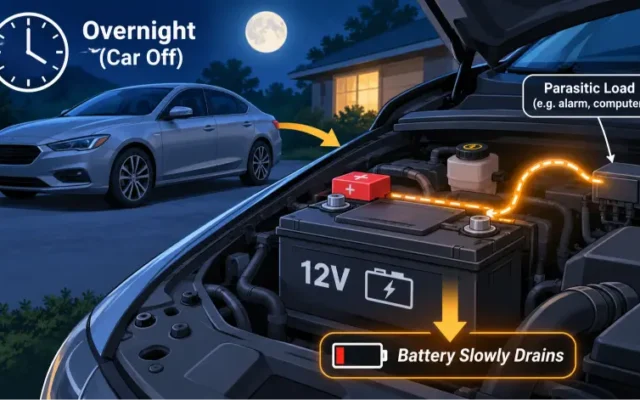
Why Is My Car Battery Draining Overnight?
By the ManualsGarage Editorial Team A car battery draining overnight most often comes down to a battery that can no longer hold a charge,…
Why Won’t My Car Start? Common Causes and First Checks
A car that won’t start usually has a weak or dead 12-volt battery, poor battery connections, a failing starter, or a fuel or ignition…
1 comment